 |
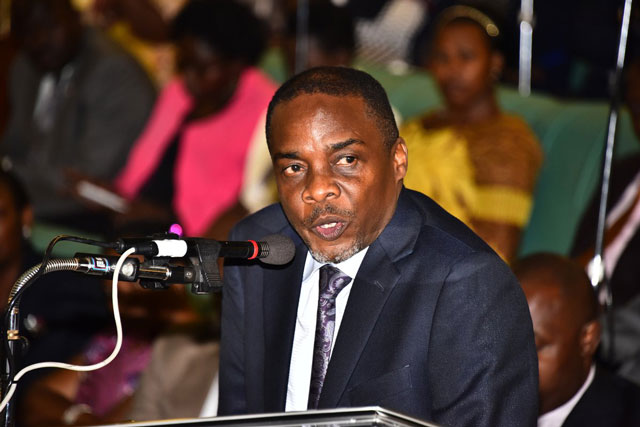
| Justice Kakuru read out 5 recommendations. He wants the AG to work on some of them in the next 6 months. PHOTO UG JUDICIARY |
This, a few days before a Supreme Court two-year deadline passes for 10 election-related reforms to be made by the government's lawyer
In their judgement in the Constitutional Petitions Numbers 49 of 2017, 3 of 2018, 5 of 2018, 10 of 2018, and 13 of 2018, justices of the Constitutional Court last week urged the Attorney General to urgently push legislative reform in several areas.
The justices demanded a constitutional review commission be constituted, and inquiry on police conduct be set up. The also asked a forensic audit be done of accounts of the 10th Parliament.
The justices in their recommendation for reforms in parliament, referred to the Supreme Court ruling that had set a two year deadline in 2016 for action by the Attorney General.
 |
| Attorney General William Byaruhanga at parliament recently. |
"By majority decision (Owiny – Dollo, DCJ/PCC; Kasule, Musoke, Barishaki Cheborion, JJCC; with Kakuru JCC dissenting), the Court declared that sections 1, 3, 4, and 7, of the Constitution (Amendment) Act No. 1 of 2018, which remove age limits for the President, and Chairperson Local Council V, to contest for election to the respective offices, and for the implementation of the recommendations of the Supreme Court in Presidential Election Petition No. 1; Amama Mbabazi vs Yoweri Museveni, have, each, been passed in full compliance with the Constitution; and therefore remain the lawful and valid provisions of Constitution (Amendment) Act No. 1 of 2018."
 |
| Justice Owiny Dolo (middle) headed Constitutional Court. |
The consolidated recommendations from the rulings of the Constitutional Court Justices are:
(1) There is urgent need for the Attorney General to bring before Parliament a proposal to constitute a Constitutional Review Commission under the Commission of Inquiry Act Cap 166 detailing 15 therein terms of reference, for amendment of the Constitution. That Commission be tasked with a duty of seeking the views of the people of Uganda in a period of not less than six months on all proposed amendments and to make proposals to Parliament.
(2) A similar commission of inquiry be set up to investigate, determine and make recommendations regarding the apparent brutality of the Police against the citizens of this Country with a view of seeking a remedy to this mischief.
(3) The Government provides sufficient funds for this purpose.
(4) The Attorney General issues within a period of six months from date hereof guidelines to the Police in their implementation of the Public Order and Management Act and a copy thereof be submitted to the Constitutional Court.
(5) The Auditor General carries out a forensic audit of Accounts of the 10th Parliament, and a copy of the resultant report be submitted to the Constitutional Court and to the Minister of Justice and Constitutional Affairs.
(6) Parliament puts in place Rules/guidelines to provide for and facilitate public participation of the people in issues of amendment of the Constitution that are not the subject of a referendum or approval by district councils, and also in others where such participation is necessary. These Rules/guidelines should enable Parliament and the Courts of law to determine whether or not the people have effectively participated in the amendment of the constitution. The appropriate provisions of the Kenya and South Africa Constitutions may provide some guidance in this respect.
(7) The provisions of the Parliament (Powers and Privileges) Act, and other relevant laws and Rules notwithstanding, there is need for Parliament to put in place a mechanism whereby Members of Parliament lawfully carrying out their duties and responsibilities as representatives of the people, are not prevented and/or interfered with in carrying out their responsibilities by directives be they of a security nature or otherwise, like those AIGP Asuman Mugyenyi issued to all Police Stations as regards the consultative meetings that the Members of Parliament were carrying out. A mechanism whereby, for example, amongst other proposals, the Speaker’s input is first sought before any such actions and/or directives are taken and issued by any authority, may go a long way in enhancing the very essential role of Parliament as the springboard through which all of Ugandans participate in promoting Constitutionalism in Uganda.
 |
| Chief Justice Katureebe |
Two years ago, the Supreme Court had it its detailed reasons for their ruling in the Uganda Presidential Election Petition No 1 of 2016 identified 10 key reforms that it wants the Attorney General to implement ahead of the next elections.
“The Attorney General must follow up the recommendations made by this court with the other organs of state, namely parliament and the executive,” Justice Jotham Tumwesigye said on behalf of the court in August 2016. “The Attorney General shall report to the court within two years from the date of this Judgment the measures that have been taken to implement these recommendations.”
The Supreme Court that had Chief Justice Bart Katureebe, Justice Joram Tumwesigye, Justic Kisaakye, Justice Arach Amoko, Justice Nshimye, Justice Mwangusha, Justice Opio-Aweri, Mwondha, and justice Tibatemwa-Ekirikubinza noted that in the past two Presidential Petitions, the court made some important observations and recommendations with regard to the need for reform in the area of elections generally and Presidential elections in particular, many of which have remained unanswered by the Executive and the Legislature.
The Ugandan judges said this as they gave detailed reasons for the judgment they made earlier that year, throwing out the legal challenge by Amama Mbabazi to President Yoweri Museveni’s fifth-term election victory.

Areas the court identified that in their view needed reform were:
1. The Time for filing and determination of the petition: In the course of hearing this petition, the issue of the inadequacy of the time provided in Article 104(2) and (3) of the Constitution for filing and determining of presidential election petitions came up.The same issue was also pointed out by this Court in the two previous presidential election petitions. The 10 day period within which to file a presidential election petition and to gather evidence and the 30 days within which the Court must analyze the evidence and make a decision as provided under Article 104(2) and (3) of the Constitution and section 59(2) and (3) of the PEA is inadequate. We recommend that the period be reviewed and necessary amendments be made to the law to increase it to at least 60 days to give the parties and the Court sufficient time to prepare, present, hear 5 and determine the petition, while at the same time being mindful of the time within which the new President must be sworn in.
2. The nature of evidence: Whilst the use of affidavit evidence in presidential election petitions is necessary due to the limited time within which the petition must be determined, it nevertheless has serious drawbacks mainly because the veracity of affidavit evidence cannot be tested through examination by the Court or cross-examination by the other party. Affidavit evidence on its own may be unreliable as many witnesses tend to be partisan. We recommend that the Rules be amended to provide for the use of oral evidence in addition to affidavit evidence, with leave of court.
3. The time for holding fresh elections: Article 104(7) provides that where a presidential election is annulled, a fresh election 20 must be held within 20 days. We believe this is unrealistic, given the problems that have come to light in the course of hearing all the three petitions that this Court has dealt with to-date. In all these petitions, the Commission has been found wanting in some areas. Importation of election materials has sometimes been a problem. Securing funds has also often provided challenges.Therefore, to require the Commission to hold a free and fair election within 20 days after another has been nullified is being overly optimistic. A longer and more realistic time-frame should be put in place.
4. The Use of technology: While the introduction of technology in the election process should be encouraged, we nevertheless recommend that a law to regulate the use of technology in the conduct and management of elections should be enacted. It should be introduced well within time to train the officials and 10 sensitize voters and other stakeholders.
5. Unequal use of State owned media: Both the Constitution in Article 67(3)and the PEA in section 24 (1), provide that all presidential candidates shall be given equal time and space on State-owned media to present their programmes to the people. We found that UBC had failed in this duty. We recommend that the electoral law should be amended to provide for sanctions against any State organ or officer who violates this Constitutional duty.
6.The late enactment of relevant legislation: We observed 20 that the ECA and the PEA were amended as late as November, 2015. Indeed the Chairman of the Commission gave the late
amendment of the law as the reason for extending the nomination date. We recommend that any election related law reform be undertaken within two years of the establishment of the new Parliament in order to avoid last minute hastily enacted legislation on elections.
7.Donations during election period: Section 64 of the PEA deals with bribery. We note that Section 64(7) forbids candidates or their agents from carrying out fundraising or giving donations during the period of campaigns. Under Section 5 64(8), it is an offence to violate Section 64 (7). However, we note that under Section 64 (9) a candidate may solicit for funds to organize for elections during the campaign period. Furthermore, a President may in the ordinary course of his/her duties give donations even during the campaign period. This section in the law should be amended to prohibit the giving of donations by all candidates including a President who is also a candidate, in order to create a level playing field for all.
8. Involvement of public officers in political campaigns: The law should make it explicit that public servants are prohibited from involvement in political campaigns.
9.The role of the AttorneyGeneral in election petitions: The Attorney General is the principal legal advisor of Government as per Article 119 of the Constitution. Rule 5 of the PEA Rules also requires the Attorney General to be served with the petition. We found that several complaints were raised against some public officers and security personnel during the election process. However, the definition of “respondent” in Rule 3 of the PEA Rules as it currently is, does not include the Attorney General as a possible Respondent.Further, Rule 20(6) of the PEA Rules, provides that even when a Petitioner wants to withdraw a petition, the Attorney General can object to the withdrawal. The law should be amended to make it permissible for the Attorney General to be made Respondent where necessary.
10.Implementation of recommendations by the Supreme Court: We note that most of the recommendations for reform made by this Court in the previous presidential election petitions,have remained largely unimplemented. It may well be that no authority was identified to follow up their implementation. We have nevertheless observed in this petition that the Rules require that the Attorney General be served with all the documents in the petition. We have further noted that the Attorney General may object to withdrawal of proceedings. Therefore the Attorney General is the authority that must be served with the recommendations of this Court for necessary follow up.


