Showing posts with label Uganda. Show all posts

Thursday, 31 October 2024

Roma Locuta Causa Finita: Archbishop says Catholics need not worry about census figures

Roma Locuta Causa Finita. Latin for, 'the matter is settled by he who knows more.......Kampala Archbishop, His Grace Dr Paul Ssemogerere, has said he is more worried about Catholics, especially children, moving to other faiths, than by the portrayal by Uganda Bureau of Statistics (UBOS) that church numbers are declining.

The Archbishop said he personally had no doubt about the size of Uganda’s Catholic population because, he is overwhelmed by numbers when he goes out for baptisms, confirmations and weddings.

“I hope you saw the census results? They seem to indicate that the number of Catholics has reduced and many of you were concerned. I am not worried at all. The truth is that I am often overwhelmed by the number of children at baptisms,” Archbishop Ssemogerere told the congregation gathered at Rubaga on Sunday to celebrate the 58th Kampala Archdiocesan Day.

For confirmation, where it is the duty of the Bishop to anoint every child individually with oil, Dr Ssemogerere revealed that, nowadays he seeks help from priests to complete the ceremony.

“A Parish Priest recently even asked me to deploy more priests in his area. He told me that there were so many Christians, and he needed help to manage the big number,” he said, quoting Matthew 9:37-38, which says, ‘The harvest is plentiful, but the workers are few’.

CLICK to READ FULL STORY


Thursday, 21 January 2021

NRM's win is a victory for a united and peaceful Uganda


UPDF doing community work. It is people focused, and
did well ensuring peace during the elections


OPINION | Apollo Otawi  in Tororo |  At the time of the 1985 coup that saw Dr. A.M Obote (RIP) thrown out of the presidency by his own colleagues, there was a mass uprising against non-Baganda in areas of Kayunga, Mukono, Luwero and parts of the then Mpigi district.

People's properties and lives were lost. No one was allowed to carry anything from their homes. Some people from Tororo trekked all the way back home. The message was clear. Buganda was not a place for non-Baganda.

At about the same time, the National Resistance Army (NRA) was consolidating their pending military victory over the government's forces, and one of their strengths was working with the people, irrespective of tribes and religion. The Luwero triangle, in the heart of Buganda, was the home from which they launched the final takeover of Tito Okello Lutwa's government in January 1986. 

The arrival of the NRA was a game changer in the political life of the country. At the fall of Kampala and the subsequent run over of the rest of the country, they preached against sectarianism and segregation. 

They wooed the other tribes, who had resisted the new revolutionary forces as the went thru Busoga, Teso up to the far north . It was time for reconciliation and there was a sense that co-existence was possible.

Fighters from rebel groups like FEDEMO, UFM of Kayira, Moses Ali's WNRF, Peter Otai's outfit, our own FOBA from the east, were all amalgamated into the NRA. It would gradually become a National Army courtesy of these integration actions.

Disciplined army

With the popular politicization retreats in Nabiisojjo and Kiburara, these fighters were taught how to work with the civilians.

The result was an Army that realised its main role was to protect the lives of all Ugandans and their properties. This naturally gave birth to one of the most disciplined armies in Africa.

The UPDF have since worked with the world's elite armies from countries like the US and Britain in peace keeping roles across the continent, but mainly in Somalia where they form the core of the African Mission in Somalia (AMISOM).

Today's UPDF , a direct product of the NRA, has now become a role model of what armies should be like in Africa. In pursuit of their missions, they execute without fear or favour.

It is therefore not surprising that the government requested them to compliment the Uganda Police in providing for a peaceful election process that is yet to conclude. The calm on voting day is testimony of the effectiveness of the people's army.

Cost of muli-partyism

On the political wing, the NRM, had in the 80s and early 90s tried to explain to Ugandans the likely mishaps political parties create in democracy in Africa. The NRM preached for the individual merit basis as systems of governance.

The pressure from the Western World, and sections of Ugandans, led to a referendum in 2005, which voted to opt for a multi- party democracy.

The NRM reluctantly agreed to the new type of democracy, forming the NRMO as a political party. The revolutionists decided to play the party politics, but still maintain the revolutionary methods of work.

Enter NUP

After FDC, DP and UPC failing to have an impact over the years of multiparty politics, in came the recently formed National Unity Platform (NUP) party.

It started off as a people's movement, but was in my observation, soon taken up by cliques who had sectarian tendencies and through propaganda preached a divide in politics on tribal basis.

It gave them an opportunity to seek change in the leadership, not based on nationalism, but for the benefit of individual partisans, who clearly wanted a particular group of peoples to take over the country.

Fortunately, the Ugandans, had become wiser, having tested the real pro-people governance and broad-based politics of the NRM.

They knew what entrusting an organization like NUP would cause in in our young democracy.

It's on this basis, that at the time of the just concluded elections, they chose to maintain the status quo and let the NRM continue to lead.

It was a testimony, that the Ugandans wanted an organization that was ready to accommodate Ugandans from all walks of life.

Now that the Ugandans have decided, it's time to get back to our tools and work for the betterment of our nation.

I therefore congratulate the Ugandans for realizing their needs and voting correctly to defeat sectarianism and all tendencies of segregation.

I also want to acknowledge the security organizations, for standing strong against elements of division, that had become a threat to our otherwise young democracy.

We need a country that is nationalistic in character, to provide for all Ugandans without segregation.

******

Apollo Otawi is a proud Ugandan and social media critic


Friday, 1 January 2021

Tororo in mourning as Paul Etyang passes on


Paul Etiang (RIP)

Former Third Deputy Prime Minister Ambassador Paul Orono Etiang has passed on at IHK in Kampala, where he had been admitted since Monday December 28

The diplomat, 82, was hospitalised after developing symptoms similar to that of COVID-19. The cause of his death has however not been confirmed yet.

Etiang was a veteran of Tororo politics, where he was since the days of Idi Amin, the top cabinet appointment from the district. 

Tributes poured in from across the country when news of the death was announced.

"Rt Hon Paul Orono Etiang was a consummate diplomat who served Uganda in different capacities with distinction. May the Almighty God rest his soul in eternal peace," said Prime Minister Dr Ruhakana Rugunda in a condolence message.

"In his retirement, Paul Etiang remained a valued pillar who cherished unity and development. We have been in regular touch with his family during his period of sickness. The health workers did the best the could, but the Almighty God had the final say."

Etiang is the father of Capt Michael Etiang who recently flew Uganda's new Airbus plane from Toulouse to Entebbe as Chief Pilot, and was husband of Zahara Etyang, a Tanzanian.

"Uganda and Tororo in particular has lost an icon, an elder statesman, one of the few people I know who had the opportunity to serve in all governments. As kids, we all grew up admiring and wishing to be like him in the future. May his soul RIP," said Charles Olweny 'Mokolimbo' when he learnt of the death of Etiang. Olweny is contesting for the MP slot in Tororo Municipality, where Etiang hailed from.

All Tororo's top politicians paid tribute to Etiang for his leadership in the district, country, region and internationally.

"Etyang was a consummate public servant. He was disciplined, hardworking and incorruptible. They belonged to a generation that set moral, ethical and work standards worth emulating," remarked Fox Odoi-Oywelowo. Fox is a former legal counsel at State House and NRM flag bearer in the MP contest in West Budama North East Constituency.

Former Tororo Municipality MP Sanjay Tana hailed Etiang.

“Tororo has lost an icon, a uniting factor and the country has lost a statesman given his service to all regimes. So for us as the young generation, we have looking onto his as a role model. He played clean politics without intrigue,” Sanjay said.

Okoth Nyalulu, a prominent administrator from Tororo and former RDC, also paid tribute to the former Prime Minister.

"As Chairman Padhola Elders' Forum, we are greatly saddened by the death of the elder states man, Paul Orono Etyang. Tororo will dearly miss his wise counsel. May the good Lord grant him eternal rest," Nyalulu said.

Etiang as Information minister engages with the New Vision
administration and board in the early 90s. NEW VISION PHOTO

Etiang joins the NRM

When the NRM government took power, Paul Etyang Orono was working as a diplomat with the United Nations in New York. 

He was convinced to return home, managing several ministries including that of Information. His major contribution while he was information minister was the role he played in the liberalization of the media in the early 1990s. 

 "When NRM took power, they came up with an idea of having a government of national reconciliation by appointing ministers on a regional basis. They needed people who knew how to manage government affairs. The policy at that time was to pick ministers on the basis of experience and from Tororo, I was the only one who met their needs," he told New Vision in an interview then.

Orono Etyang will also be remembered for advising  President Yoweri Museveni in 2005 to split Tororo into three districts to strengthen Movement support in the region.

It led to the agitation by Tororo county for their own district, a breakaway from West Budama, and  they also asked to take Tororo town as their headquarters.

The residents of West Budama did not object to Tororo counry becoming a district, but with their headquarters in their main town of Kwapa, not Tororo Town.

Pallisa, Busia and Butaleja had earlier all broken away from Tororo, and gone to form their own headquarters. (READ history of districts in Uganda)

He is the second pillar of the NRM to die in the past fortnight. Second Deputy Prime Minister Ali Kirunda Kivejinja, 85, passed on after struggling with COVID-19 at Mulago earlier this month.

 CLICK HERE FOR MORE ON THE ETYANG STORY 

.

Etiang (left) with colleagues at Foreign Affairs. He was
acting minister as early as 1973, went to the UN, then returned
in the 80s as minister, then Deputy Prime Minister.
NEW VISION PHOTOS


Wednesday, 23 December 2020

KCCA right to rename stadium after Phillip Omondi, the greatest ever


📍 Uganda 🇺🇬 population figures ✳️ Aged 0-14yrs - 46% ✳️ Aged 10-24yrs - 34.5% ✳️ Aged 15-64yrs - 52% ✳️ Aged 65+ - 2% ✳️ Life expectancy 64yrs

Phillip Omondi was born in 1957 in Tororo, and died 22 years ago while still in his early 40s. Up to 60% of Uganda's population today, were not yet born when he died in 1999.

Omondi is considered the greatest Ugandan player by everyone who was blessed to watch him play  —  a very small minority today  —   which explains why when MTN acquired 10 year naming rights for the KCCA FC stadium and renamed it the MTN Omondi Stadium, there wasn't as much euphoria across the country, as should have been.

The debate on who was the greatest between Omondi, Magid Musisi and others, is similar to the one between World Cup winners Pele, Mardona and others. 

While that debate will never end, Abedi Pele described him as one of the best Africa has produced, when he visited Uganda in 2007.


Lord Mayor Lukwago and MTN officials at the official
renaming ceremony for the Phillip Omondi stadium
at Lugogo, in Kampala

Omondi had many firsts, that makes him revered. First Ugandan top scorer at the Nations Cup finals, one of the first Ugandans to play professional football abroad etc etc....but for us in the Media, one of the first former top footballers to write a column for a newspaper in Uganda.

Omondi was that final piece as we at the New Vision Sports desk assembled a winning team to cover the 1998 World Cup in France. That team was to end up having in it newly recruited writer Kenneth Matovu (RIP), and Omondi (RIP), who had long retired.

We struck a deal, through another colleague, James Bakama, who also grew up in the Naguru estate that produced many spors legends and John 'The Beast' Mugabi, and the Omondis. Baks as we call him, would pick Omondi's hand written notes from Naguru, come type them on the typewriter, and I would edit.

That 1998 coverage must be the greatest ever in New Vision's history.

Not only did we have Phillip Omondi among our columnists, our main reporter Kenneth Matovu, at my prompting, wrote a block-buster of a preview to the World Cup, and we dared to say in our headline on the back page..... "Why France will win the World Cup"

The article run June 9th, a day before kick off and coincided with our weekly editorial committee meetings.  Those meetings had several editors, including David Sseppuuya, former sports editor, and William Pike from the UK,  who were very knowledgeable in matters sport. There were several anxious looks my end, since I was sports editor.


CLICK TO READ


Soon after the kick-off, I flew to Cardiff in the UK for a three month diploma in international journalism course. On July 12, 1998, I watched the final in my room, where a fight nearly ensued between me and my Brazil-supporting room mate from Malawi John Saini.

CLICK TO READ FULL STORY

That same day July 12, a month since Kenneth Matovu wrote his article, France won the World Cup by thrashing everyone's favourite Brazil - as if following his script letter for letter!

Omondi died a year later, and one of his last words to colleague and writer Hassan Badru Zziwa of The Observer, after he had been put on oxygen at Mulago, were “Go help me thank Ugandans for the love they have showed me.”

REST IN PEACE  Omondi. Uganda will never forget you!

*******

Related stories

Why Omondi is the greatest!

EZRA #BUNYENYEZI: A golfer, and a fine gentleman!


.


The 10-year deal gives MTN naming rights to the club’s home grounds at Lugogo

The stadium will now be renamed the MTN Omondi Stadium in honor of Philip Omondi, a legend that gave so much to football in Uganda.

The partnership reinforces MTN Uganda’s role in supporting football and sports in Uganda.

MTN Uganda and KCCA Football Club (KCCA FC) have today inked a ten year partnership that will give MTN naming rights to club’s home ground facility located at Lugogo, in the outskirts of the city centre.


Philip Omondi played for local side Kampala City Council FC from 1973 to 1988, when he moved to the United Arab Emirates to join Sharjah. Omondi played for the Uganda national football team at the 1974, 1976 and 1978 African Cup of Nations, where he was the leading goal-scorer, in the tournament that Uganda finished second. He also helped the team to the 1973 and 1977 CECAFA Cup titles. He later on coached some local football clubs.


: OmondiSeveral great footballers have come and gone. There was Majid Musisi, Paul Hasule and Jimmy Kirunda but John Phillip Omondi towers over them as the greatest. HASSAN BADRU ZZIWA reveals why:

There was hardly any euphoria when The Cranes opened their 1978 Nations Cup Group B match against Congo-Brazzaville.

In the eyes of the capacity crowd at the Kumasi Municipal Stadium, Uganda’s stout-built number15, John Phillip Omondi, was a non entity. After all, he had played in two previous tournaments (1974 & 1976) but had not created a big impact.

It took him just 45 seconds to open Uganda’s onslaught in a 3-1 win and followed up with the consolation goal against Tunisia in a 1-3 loss. [Several references however credit this goal to Sam Musenze]

Omondi became an instant hero in the last Group match against defending champions Morocco. Anything but a win would have eliminated Uganda and Omondi hammered in the final nail in a 3-0 win that sealed Morocco’s fate.

Few would have anticipated Omondi to be the tournament’s most feared striker. And to confirm his newfound status, Omondi single-handedly obliterated Nigeria in the 2-1 semi-final win.


“We also became spectators when he dribbled past the entire Nigerian defence and made goalie Emmanuel Okala dive three times before tapping into an empty net,” recalls former team-mate Tom Lwanga, who played in central defence in the tournament.

Uganda eventually finished runners-up behind Ghana but didn’t return empty handed as Omondi finished top-scorer with four goals.


Omondi magic


Omondi had the rare ability of scoring goals, creating them as well as the knack to crack any defence. As such he was dubbed the technician and soccer wizard.

He was so crafty that he could virtually do anything with the ball. At times he would make you think he had the ball tied to his boot laces. And when it came to head and chest control, he was unrivalled and his passes had a pin-point precision.

Former Cranes coach David Otti describes Omondi as a rare package. “Nobody can match his skills; I have never seen a player like him, he could transform a match in a flash,” he recalls.


On a visit to Uganda in 2007, Ghanaian football legend Abedi Pele described Omondi as one of his idols and one of the most talented footballers the continent has produced. Pele went as far as describing the admiration he had for Omondi when watching him at the 1978 Nations Cup..

Lwanga adds that Omondi was not a regular scorer. “All his goals were scored from within the penalty area after dribbling past defenders. And when he wasn’t scoring, he was making for others. That’s why most strikers who played alongside him emerged top scorers,” he says.


“You couldn’t know what he was going to do next because he was so unpredictable. He also loved learning new things and used to talk to his seniors like me how things are done,” says Polly Ouma a former Cranes star who played with Omondi in the 70s.

“He wasn’t the strongest of strikers and most times he avoided man markers,” says Ouma.


Who is Omondi


He was born to Kenyan parents in 1957 Tororo and the family moved to Naguru Housing Estates when he was still young. He went to St. Jude Primary School and later Kololo SS.  Omondi’s first passion was boxing until he was frustrated by a judge’s decision during a local tournament. He decided to quit boxing.According to Lwanga, Omondi had been lured to boxing by his housemate and former national boxer Shadrack Odhiambo.

That’s when he decided to take on football. One day in 1969 when he was hanging around the Lugogo hostel, it happened that The Cranes had camped there before the CECAFA Cup preparations.


He awed Cranes coach Burkhard Pape and team Manager Andrew Wassaka Musoke with his ball juggling skills and soon became part of The Cranes during the 1969 Challenge Cup as a ball boy.

He joined Naguru Youth in 1970, then Fiat FC before KCC FC coach ‘Mister’ Bidandi Ssali spotted him in 1973 together with Tom Lwanga.


Buganda rejects Omondi


During the Inter Region competitions in 1973, Buganda’s Kezekia Segwanga Musisi lured the young Omondi to the Buganda team. But after a few training sessions, coach Robert Kiberu dropped him.

On his way home, a dejected Omondi met Northern Region coach David Otti who gave him a lifeline. “I played with him in the midfield during our training and I realised that he had a unique skill,” recalls Otti.

Omondi would later return to haunt Buganda in the final when he scored one of the goals that won Northern the Cup. He was also voted the best player of the tournament.


Omondi escape death


Omondi’s career was not all that smooth.

On April 10, 1976 during a league match, Omondi was severely injured after a collision with a Kilembe goalie Kikomeko. He suffered a ruptured pancreas and underwent three surgical operations; one of them at Mulago Hospital and another one in the England.

In that period, he was pronounced dead on at least two occasions, many experts ruled out his return to football.

But Omondi was not ordinary. He made a dramatic return on June 22, 1977 and featured in the KCC game against NIC and scored one of the three goals.

He also helped KCC win the 1978 East and Central Africa Club Championships in January in Kampala.


Professional


In 1979, after a successful Nations Cup, Omondi together with Lwanga and Jimmy Kirunda joined the paid ranks. He joined United Arab Emirates side Sharijah FC with Tom Lwanga joining Rasal Kharima and Jimmy Kirunda opted for Abu Dabi’s Imarati.

Another injury in 1981 cut short his UAE sojourn and in 1983, he quit professional football and returned back home.


Re-joined KCC


He rejoined KCC and helped the club win the 1983 and 1985 league titles plus the Kakungulu Cup in 1984 and 1987.


Unmatched Cranes career


It’s extraordinary that Omondi made it to The Cranes squad directly from the second division. That was after his outstanding show in the Inter Region tournament and was part of the team that won the CECAFA Cup in 1973. He also netted a brace on his debut against Somalia.  

Between 1979 and 1982 he was in United Arab Emirates playing professional football. He returned in 1983 and rejoined The Cranes, scoring a hat-trick in 1986 when Uganda beat Kenya 3-1 to lift the Independence Cup.

In 1987, he scored twice in the Nations Cup qualifier against Somalia and also scored in both ties between Uganda and Cameroon in the next round. The Cranes however failed to make it and Omondi quit the national team.


Coaching


In 1987, Omondi was among the ten upcoming coaches who went to Germany for a coaching course. Upon return he played again for KCC and quit the club at the end of the season. He coached Bank of Uganda for a few months and also had a coaching stint with KCC in 1992 before completely retiring from football.


His death


It’s no secret that one of Omondi’s best friends was alcohol; he was so addicted that he used to leave bars in the wee hours of the morning. On April 20, 1999, he was admitted at Mulago Hospital where he was diagnosed with tuberculosis. “Go help me thank Ugandans for the love they have showed me,” Omondi who was put on oxygen told me in a faint voice. Sadly he passed away the following day at 5:30a.m. and was buried at Maile village, Gayaza in Wakiso District.

That was Omondi, the greatest. But despite all of his achievements, there is virtually nothing apart from records to show that Omondi ever played football.


Tuesday, 22 December 2020

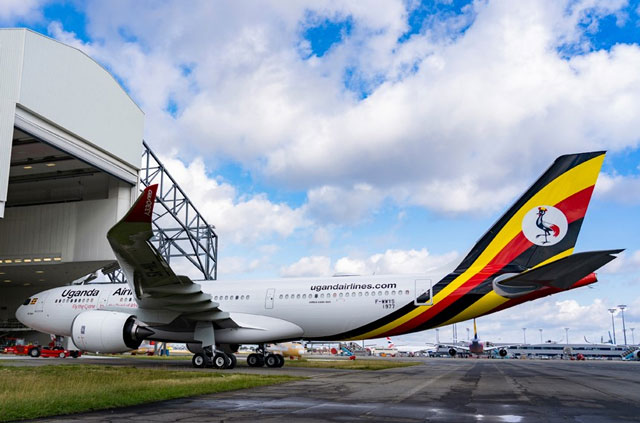
IN THE SKY: Uganda Airlines Airbus takes off from France to Entebbe

📌Arrives 🇺🇬 Uganda today
#Airbus
#A330neo

💰unbeatable economics
🌍excellent range versatility
💺superior comfort

TUESDAY, 3.00AM -  The new Uganda Airlines plane, an Airbus A330neo, has just taken off on an 11-hour journey from Southern France, heading to Entebbe Airport.

The A330neo is the latest version of the most popular wide-body airliner and will be the first Airbus aircraft delivered to Uganda Airlines, which was re-established in 2019.

President Yoweri Museveni is expected to receive the plane ' Mt Elgon' officially when it lands at Entebbe Airport. On board are Ugandan pilots that are flying the US$259 million plane, and a delegation of close to 30 that flew to Toulouse to receive the new Airbus.

In a statement Monday, Airbus said the country’s  flag-carrier had made the perfect choice of aircraft needed to operate in the new normal of post-COVID-19 recovery. The A330neo will enable the newly re-launched airline to launch its long-range operations with non-stop intercontinental flights to the Middle East, Europe and Asia.

"Thanks to its tailored, mid-sized capacity and its excellent range versatility, the A330neo is considered the ideal aircraft to operate as part of the post-COVID-19 recoverym," Airbus said in a statement.

The A330neo is a true new-generation aircraft, building on the features of the popular A330 and using technology developed for the A350.  (Click here to follow LIVE flight path as plane enters Africa's airspace)

The aircraft burns 25% less fuel per seat than previous generation competitors. The A330neo cabin offers a unique passenger experience with more personal space and the latest generation in-flight entertainment system and connectivity.

Featuring Airbus’ Airspace cabin, passengers can enjoy a unique experience which includes 20 full-flat, business-class beds, 28 premium-economy seats and 210 economy-class seats, totalling 258 seats.

"In line with the Company's strategy to keep offering its customers unbeatable economics, increased operational efficiency and superior passenger comfort, the A330-800 is the latest addition to Airbus’ commercial aircraft product line," Airbus said.

Etiang to fly plane to Uganda

An hour before the plane took off from Toulouse, Chief Pilot Capt Michael Etiang told UBC TV that it was an honor to be flying the new bird home. (Etiang is son of former long serving Minister Paul Etyang from Tororo)

"There has been a lot of training we have gone through and a lot of effort by government to acquire a machine like this. It is a good chance for us to make our mark in international aviation, give passengers a more direct experience of travel to wherever they want to go. It will reduce the risk of exposure to COVID by going through many airports."

He added that, "For myself it is a real honor. I have always wanted to be a pilot, and this is a culmination of a long dream."

Etiang hailed government for reviving Uganda Airlines, which he said is an opportunity for the country's flag to fly high around the world.

"I need to thank the Government. The president for his commitment. He made a promise to revive the airline and he has followed through on that, and for that we all owe him a deep debt of gratitude.  I thank parliament for approving the funds, the public for supporting us and all my colleagues at Uganda Airlines for trying to create something new. The Airbus is a fantastic aircraft, very automated and is at par with any other machine. All glory to God," he said.


The brand new Ugandan airbus dubbed Mt Elgon, rolling out of
 the paint-shop in Toulouse last month. PHOTO AIRBUS

In a recent interview, Cornwell Muleya, the company acting CEO said because of the COVID pandemic, they will now start of international flights next year, and not October as earlier planned.

Muleya said “We’re targeting that we receive the aircraft in the last quarter [of the year] at least by December so that early in the New year we can launch our operations.”

He added that “We’re targeting mainly three connections to overseas markets, which is Dubai, London as well as the Chinese market in Guangzhou.”

Uganda currently has four bombardiers – CRJ 900 series, plying up to eight regional routes since August 2019. 

The A330neo

Launched in July 2014, the A330neo Family is the new generation A330, comprising two versions: the A330-800 and A330-900 sharing 99 percent commonality.

The plane, according to Airbus, builds on the proven economics, versatility and reliability of the A330 Family, while reducing fuel consumption by about 25 percent per seat versus previous generation competitors and increasing range by up to 1,500 nm compared to the majority of A330s in operation.

Powered by the latest Rolls-Royce Trent 7000 engines and featuring a new wing with increased span and A350-inspired Sharklets, the A330neo provides an unprecedented level of efficiency.

The cabin provides the comfort of the new Airspace amenities including state-of-the-art passenger inflight entertainment and Wifi connectivity systems, amongst others.

Airbus has only sold 14 of the -800 version of the A330neo compared to 318 of the A330-900, making news of its deliveries a rarity indeed. The shorter version of the A330neo was first delivered to launch customer Kuwait Airways in October.

Tuesday, 15 December 2020

TODAY IN HISTORY: Obote sworn in as President for second time December 15, 1980


Obote being sworn in by the Chief Registrar of the
High Court of Uganda A.M.C Ochwo on
 December 15, 1980

📌 MONDAY, DECEMBER 15, 1980

✳️ Obote sworn in aged 55, 

✳️ UPC won 69 seats in the 126-seat Parliament

✳️ Ssemogerere's DP won 55 seats, stayed away from the inauguration


EXACTLY 40 years ago today, Apollo Milton Obote was sworn in for a second time as President of Uganda, becoming the first leader of an African nation to be overthrown in a coup and then win re-election.

"In my life I have faced challenges and intimidating tasks," said Obote, who led Uganda from independence until he was overthrown by his army commander Idi Amin in 1971. "But never have I been faced with formidable challenges such as we now face."

He then prepared to take on the challenge of rebuilding a shattered economy. "We have problems, we have friends, we have the ability to do a number of things, we have natural resources," said Obote, who has promised to abandon past socialist views to rescue the country's economy from the chaos of the Amin years.

The elections held December 10 and 11 1980, were controversial in many ways, but the  Commonwealth Observer Group’s final report stated that  “The people of Uganda, like some great tidal wave, carried the electoral process to a worthy and valid conclusion.”

They were impressed by the voters’ enthusiasm and patience, and their initial judgment (expressed before results were announced) was that the elections “should broadly reflect the freely expressed choice of the people of Uganda.”

It was the belief that the 1980 elections were rigged that led Yoweri Museveni to begin a long — and ultimately successful — guerrilla war against the UNLA supported governments of Dr Milton Obote, who was then overthrown again by his army Commander, this time Tito Okello Lutwa in 1985, before the NRA won the war a year later.

ELECTION RESULTS

Party

Votes

%

Seats

+/–

Democratic Party

1,966,244

47.1

50

+26

Uganda People's Congress

1,963,679

47.1

75

+38

Uganda Patriotic Movement

171,785

4.1

1

New

Conservative Party

70,181

1.6

0

New

Invalid/blank votes

2,419

–

–

–

Total

4,174,328

100

126

+44

Registered voters/turnout

4,898,117

85.2

–

–

Source: Wikipedia (Not official tally of results) 

*******

HOW THE FOREIGN PRESS REPORTED THE INAUGURATION

********

THE WASHINGTON POST

Ugandan President: Controversial Figure With a Unique Past

By Jay Ross

December 15, 1980

Apollo Milton Obote, the once and new president of Uganda, has won a unique place in African politics. He is the first leader of an African nation to be overthrown in a coup and then win reelection.

Since Idi Amin, who had toppled Obote, was ousted last year, Obote has been the key topic of conversation in the country. Monday, almost a decade after his overthrow, Obote will be inaugurated again as president after an election marred by irregularities.

"Obote was the main issue in the election," said a longtime observer of the 55-year-old grandson of a tribal chief from the northern Lango region. "He's too controversial a figure to lead the government -- he's not the man to pull the country together."

The elections seemed to show that Ugandans either love Obote or hate him; his followers are located largely in the north and his opponents in the southern Buganda region.

Even though he lived in Tanzania in political exile for nine years as the guest of his friend, President Julius Nyerere, Ugandan memories about Obote seem to be long, mainly because he tried to destroy the power of the country's feudal kings in Buganda.

Even many of his opponents agree, however, that he has leadership ability and that his party is the best organized in the country, giving some hope that Obote can begin to pull Uganda out of its decade of chaos if he can overcome the nation's divisions.

Obote became the first prime minister of Uganda after independence from Britain in 1962.He canceled the scheduled 1967 election, rewrote the constitution and became executive president of a one-party, socialist-oriented state.

He was wounded in an assassination attempt in 1969.

A measure of his unpopularity was the celebration that occurred in much of the nation when he was overthrown by Amin, his Army chief. But later Amin presided over the killing of an estimated 500,000 people and the destruction of the economy.

Even after Amin was overthrown last year, Obote remained in the Tanzanian capital and was able to return to Uganda only after military leaders favorable toward him seized power in May.

Now, having won a second chance at the leaderdship, "he is a driven man, determined to redeem himself," a diplomat said.

Born in 1925, Obote spent his youth as a goatherd while going to local schools. He went to teacher training college in Kampala but never entered the teaching profession. He has an honorary doctorate from Long Island University in New York.

Instead, he moved to neighboring Kenya in the 1950s where he worked in a sugar factory and later in a construction firm while he trained in politics under Tom Mboya, a leading Kenyan politician assassinated in the 1960s.

He returned to Uganda and formed the Uganda People's Congress in 1959 and was elected as the first leader of independent Uganda under the party's auspices.

******


UPI United Press International 


By TOM LANSNER

KAMPALA, Uganda -- Milton Obote took the oath of office Monday as president of Uganda nine years after he was ousted by Idi Amin and called on his countrymen to unite in building 'a new future' for the African nation.

Obote, 55, whose election was disputed by the opposition party, drove in his white Mercedes Benz to the steps of Parliament where the country's new chief justice, George Masika -- attired in red robes and a white wig -- administered the oath.

'In my life I have faced challenges and intimidating tasks,' said Obote, who led Uganda from independence until overthrown by Amin in 1971. 'But never have I been faced with formidable challenges such as we now face.'

Hundreds of cheering Ugandans waved posters of Obote and sang and danced as the government and military bands played the national anthem and the theme of the Uganda People's Congress, Obote's party.

'We have problems, we have friends, we have the ability to do a number of things, we have natural resources,' said Obote, who has promised to abandon past socialist views to rescue the country's economy from the chaos of the Amin years.

'It may be difficult but together it should be possible for all of us to rebuild Uganda.'

In Washington, the State Department declined comment on Obote's election, saying it would rather await a report by a British Commonwealth observer team on alleged irregularities in the election.
Obote called upon the Democratic Party to accept last week's national elections. But party leader Paul 

Ssemogerere stayed away from the inauguration and called a strategy meeting of the party's national leadership.

The Democratic Party has charged that widespread intimidation and tampering with election returns helped Obote's party win 69 seats in the 126-seat Parliament. The Democratic Party won 55 seats and two seats went to a smaller party.

Obote told the Democratic Party its 'role as the opposition party is as challenging as the role of the UPC and the government. Our destiny is the same. We either rise or sink together.'

The new president, who spent nine years exiled in Tanzania during the Amin regime, said 'We shall work for reconciliation, we shall insist on no revenge. The past is gone, we start a new future.'
Obote's party won 17 seats -- more than the margin of victory -- after Democratic Party candidates were disqualified. While the disqualifications were based on flimsy legal grounds, the opposition party is expected to have little success in changing the results in court.

As the majority party in Parliament, Obote's party is expected to quickly increase its majority by naming nominated members. In all, 30 members are expected to be added, all loyal to the new president's party.


Thursday, 6 August 2020

National Coffee Bill passed, UCDA to register farmers


Parliament has passed the National Coffee Bill 2018 that will give more powers to the Uganda Coffee Development Authority to oversee the whole value chain of the cash crop, including registering farmers.

The object of the Bill is to reform the law to provide for the Uganda Coffee Development Authority to regulate, promote and oversee the coffee sub sector; and to regulate all on-farm and off-farm activities in the whole coffee value chain from generation of planting materials, planting, through harvesting up to marketing.

The Bill that will become law after President Yoweri Museveni assents to it, seeks to repeal and replace the Uganda Coffee Development Authority Act, Cap. 325 that only covered off-farm activities of marketing and processing, leaving on-farm activities like planting materials, nurseries, harvesting and post harvesting handling outside the scope of the law.

In the new law, a person shall nor a operate a pulp-ery, buy coffee, grade coffee for internal marketing, roast coffee, brew and operate a coffee shop or coffee store, operate a warehouse or coffee huller or process or export coffee on a commercial basis without a licence issued bv the Authority.

There were however several deletions and amendments before the bill was passed in parliament in Kampala on Wednesday. These included removing a clause to de-register coffee farmers who fail to meet standards and a 2-year jail term for those who fail to take care of their coffee plantations, plus removing powers from UCDA to determine whether land used by a farmer is suitable for coffee growing.

Clause 28 on de-registering farmers had stated that " The Authority may, after being satisfied that a registered coffee farmer has failed to comply with the terms and conditions of registration, strike off the register the name of the coffee farmer."

Coffee Uganda's number 1 export

Coffee is a significant source of income for farmers and export earnings to many nations including Uganda. In Uganda, coffee remains the leading export crop employing more that seven million people equivalent of 1.7 million households in over lOO coffee growing districts.

Uganda strengthened her position as Africa's top coffee exporter with a record 5.06 million (60kg) bags in the financial year 2019/20. All indications are that Uganda, 8th in the world, could also overtake Ethiopia as Africa's top coffee producer.

Export earnings also reached an all-time new level of US$494 million (Sh 1.8 trillion). Coffee exports for 2018/19 amounted to 4.18 million bags worth US $416 million compared to 4.45 million worth US $492 million the previous year

The National Coffee Bill aims to enhance the production of coffee as Uganda aims to produce 20 million bags by 2030.

Here is the bill (amendments done to clauses 32, 37,43, 54, 55 & 57) 

National Coffee Bill 2018 by The Independent Magazine on Scribd