Tuesday, 26 June 2018

SGR, oil and electricity top NCIP agenda as Museveni and Kagame head to Nairobi


JUNE 26, 2018 - Regional Leaders Yoweri Museveni of Uganda and Paul Kagame of Rwanda head to Nairobi on Tuesday for the 14th Summit of the Northern Corridor Integration Projects (NCIP) that will review progress on key infrastructural projects.

Among the key projects expected to feature prominently during the meeting is the Standard Gauge Railway (SGR) where significant progress has been made with Kenya having successfully completed the Mombasa-Nairobi line and has now embarked on the Nairobi-Naivasha section which is now at 50 percent completion.

According to a statement from hosts Kenya, Museveni, Kagame, Uhuru Kenyata and Salva Kiir's Special Envoy will also be briefed on the progress being made in ICT. "They will be keen on the status of the One Network Area (ONA) for voice which is fully operational in all the partner states, while ONA for data is operational in Kenya, Uganda and Rwanda," the statement from hosts Kenya added.

The NCIP is a multilateral development initiative established in 2013 and is aimed at speeding up development in the region particularly the improvement of infrastructure for ease of movement of people, goods and services in the region.

Ministers of the Northern Corridor Partner States met in Nairobi on Monday to validate a report prepared by Senior officials ahead of Heads of State Summit 

Oil refinery

Also expected to feature in the deliberations will be the progress of the oil refinery. 

Uganda signed a Project Framework Agreement (PFA) in April 2018 with the Albertine Graben Refinery Consortium to design, develop, finance and operate a refinery in Hoima. It is expected that a final investment decision (FID) will be made by May 2019. The Land for the refinery has already been acquired. 

Kenya has been requested to indicate the entity that will hold its 2.5 percent shareholding in the refinery.

Further, the leaders will assess and provide leadership on the progress being made in power generation, transmission and interconnectivity, a function that is being coordinated by Kenya.

Progress on power generation

So far, partner states have made tremendous progress in implementing their respective 220kV power transmission lines. Rwanda, Uganda and Kenya completed and commissioned their lines apart from the Bujagali-Tororo transmission line in Uganda, which is at 85% completion. In addition, partner states are working on a feasibility study on the standardization of 400kV lines, while ensuring full implementation of 220kV transmission lines.

Going forward, the four East African countries are actively stringing together power exchange agreements which are expected to be ready by end of this year and work towards a fully-fledged need based power trade in the region.


SGR progress

During the Nairobi meeting at Safari Park Hotel i, the leaders are expected to review the progress made in the implementation of the various resolutions reached at during the 13th Summit held in Kampala, Uganda on 23rdApril 2016.

Among the key projects expected to feature prominently during the meeting is the Standard Gauge Railway (SGR) where significant progress has been made with Kenya having successfully completed the Mombasa-Nairobi line and embarked on the Nairobi-Naivasha section which is now at 50 percent completion.

A commercial contract for the Naivasha-Kisumu-Malaba sections and a modern port at Kisumu has already been signed with the China Communication Construction Company (CCCC).

On its part, Uganda signed a commercial contract with China Harbor Engineering Company (CHEC) in March 2015 and recently completed the project appraisal exercise which was held parallel to the ongoing negotiations of financing which are expected to be finalized by September this year.

In Rwanda, preliminary engineering design of the new SGR line from Kampala to Kigali was completed in January 2018 while in South Sudan, preparation for a bankable feasibility study for the Nimule-Juba SGR line is on-going and is expected to be complete by December this year. Engineering Procurement and Construction (EPC) Contract for the line has been signed and the process for obtaining a commercial loan from China EXIM Bank is in its early stages.

Other agenda items expected to feature prominently during the summit include the crude oil pipeline project, the commodities exchange, human resource capacity building and land.

The leaders will also review progress made in immigration, tourism, trade, labour and services; single customs territory; mutual defence cooperation; mutual peace and security cooperation; and airspace management.

Monday, 25 June 2018

Hip-hop godfather stars at Fête de la Musique in Kampala

London hip-hop godfather Rodney P and Skitz perform in Kampala 
on Saturday. COURTESY PHOTO 
Kampala, Uganda -  The Alliance Française organised annual Fête de la Musique (World Music Day) concert climaxed on Saturday with a special show by Rodney P, known as one of the godfathers of London hip hop.

Rodney P was the main act on a day where several rising stars entertained a diverse crowd of Kampala music lovers, both young and old, foreign and Ugandan, fans of hip hop and French culture. He performed with the artist cum DJ and producer, Skitz. 

The two threw down a raw, old-school hip hop set mixed with reggae rhythms that had the crowd living their best life, from older fans who were excited to see the stars they’ve known for so long, to those who had never heard of Rodney P and Skitz and certainly enjoyed the lesson in hip hop history

The annual Fête de la Musique concert organized by Alliance Française Kampala at the French School, École Française, Des Grands Lacs followed a week of activities. The week's activities included a traditional instrument making workshop and an opening event in which Ugandan top stars, Eddy Kenzo and the Ghetto Kids, joined Giovanni Kremer to engage with migrant children in the project Voices Without Borders that uses music as a tool of repair and resilience in Uganda’s Bidi Bidi Refugee Camp.

The main concert on World Music Day, June 23rd – was sponsored by Alliance Française, the Embassy of France, École Française, Total, Brussels Airlines and SafeBoda.

Children of Kampala Breakdance show what they can do.
COURTESY PHOTOS

Ecole Francais music club perform
MC’d by Jora MC and Adele, the show started at exactly 6pm with heart-warming opening performances from the French School Music Club and Breakdance Project Uganda kids. Destiny Nsonga, a rising star, blew the crowd away with her performance just before a live band, ‘The Groovetones’ took over and had everyone dancing.


Recho makes her debut top, Yallah MC above and below, K'van


When the lady MCs stepped on stage, they stole the show. Yallah MC, one of the First Ladies of Ugandan hip hop, and newbies K’Van and Recho Rey, all performed like they were out to prove and claim their place in the mostly male dominated genre.  They indeed owned the night.

The guys were not left out. Artists such as Byg Ben Sukuya all the way from Mbale and Nemesis Keya represented hard, just before Control Posse Kongoloko and the hiphop-lingala mash up R’Afrika from DRC had everyone dancing with joy.

This was before the closing act by Rodney P, performed until midnight exactly, then the crowd left for the after party at Big Kafunda, where the celebration of music continued late into the night.

Monday, 18 June 2018

BACKGROUND TO THE BUDGET Fiscal Year 2018/19


Kampala, Uganda | The Budget for Fiscal Year 2018/19 that will be read out Thursday June14  by Uganda's Minister of Finance Matia Kasaija retains the theme “Industrialization for Job Creation and Shared Prosperity”.

It is the 4th in a series of five national budgets for delivering the second National Development Plan (2015/16 to 2019/20); and the 3rd for implementing the National Resistance Movement Government manifesto (2016 to 2021).

The sh32.7 trillion budget will reveal findings that shade new light on Uganda’s development performance over the recent past that have emerged since the last Budget approval in May 2017, according to the "BACKGROUND TO THE BUDGET Fiscal Year 2018/19" report released this month by the Ministry of Finance. (read full report CLICK)

These findings are contained in the latest round of survey data from Uganda Bureau of Statistics, and include among others the 2016/17 Uganda National Household Survey and the 2016/17 Manpower Survey. They provide conclusive evidence on Uganda’s development performance over the NDP I period (2010/11 to 2014/15) and the first two implementation years of the NDP II (2015/16 to 2016/17).

All 23 Presidential Guidelines and Directives for the period 2016 to 2021 have been integrated in the relevant sector strategies and annual work programmes that Minister Matia Kasaija will outline today. ( READ all sector targets for 2018/19)

The budget will also put into consideration measures that mirror the fact that at the East African Community (EAC) level, the 5th EAC Development Strategy for the period 2016/17 – 2020/21 was launched. The strategy provides the broad strategic development objectives that the EAC will pursue over the next five years.

Over the next five years, EAC will focus on seven (7) key priority areas namely: consolidation of the Single Customs Territory (SCT); development of regional infrastructure; enhancement of free movement of all factors of production as envisaged under the Common Market and Monetary Union Protocols; enhancement of regional industrial development; improvement of agricultural productivity; promotion of regional peace, security and good governance; and institutional transformation at the regional and Partner State levels.

Revenue Performance Outlook for FY 2018/19
Government’s current revenue target is to achieve revenue to GDP ratio of 16 percent by the FY 2019/20 as envisaged in the National Development Plan II (NDPII). The overall net revenue target for FY 2018/19 is Ushs 16,211 billion, which translates into a growth of 7.6 percent compared to the target of Ushs. 14,404 for FY 2017/18 and this translates to 14.7 percent as a share of GDP

The main drivers for revenue in F/Y 2018/19 are based on the following assumptions;
a) GDP growth of 6 percent ,
b) Stable inflation at 4.3,
c) A stable exchange rate and
d) Enhanced tax compliance


In order to enhance revenue collection, there are proposed adjustments in some tax rates aimed at widening the tax base and enhancing compliance. Government has proposed technical amendments to bring more clarity to the laws in order to minimize unnecessary disputes between taxpayers and URA, as well as dealing with issues of tax avoidance.
Also, there are proposals for additional taxincentives to promote industrialization and investment in strategic areas. The proposed policy measures for FY2018/19 are expected to raise Ushs 643.5bn, while Ushs 272bn is expected to be raised from administrative efficiency.
The aim is to achieve the policy target of 0.5 percent which in line with National Development Plan II. Government will undertake a number of policy and administrative measures to enhance revenue mobilization in FY 2018/19

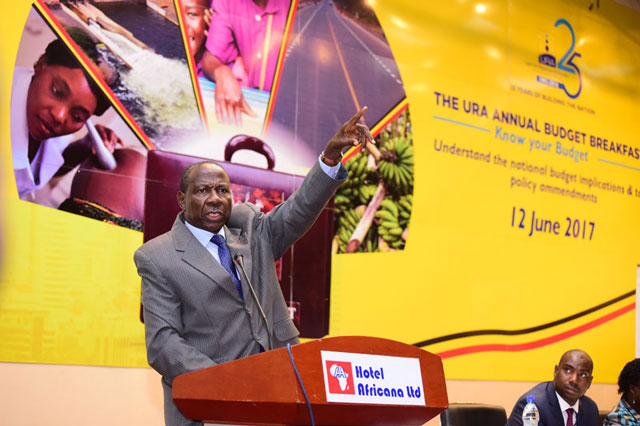
Kasaija makes a point at a URA breakfast meeting to digest the budget


Resource Envelope Projections for 2018/19
Resources available to Government for expenditure in FY 2018/19 will be obtained from domestic tax and non-tax revenue, donor grants, concessional and non-concessional external borrowing as well as domestic borrowing. Government of Uganda’s resource envelope net of arrears, Appropriation in Aid (AIA) and debt repayments is projected to amount to Ushs. 17,358.7 billion in FY2018/19 and increase to Ushs. 27,238.5 billion by FY 2022/23. Table 7.2 shows the medium term resource projections.

***Estimated revenue


Domestic revenue is projected at Ushs 16,358.8 billion in FY2018/19, equivalent to 14.6 percent of GDP. Tax revenue is projected at Ushs 15,938.8 billion (an increase of 0.4 percentage points of GDP), supported by new tax policy measures, enhanced revenue administration measures, as well as reforms to widen the tax base and enhance compliance.

External Financing
A total of Ushs 8,023.5 billion of external resources is projected to support the budget in FY2018/19. Of this, Ushs 7,734.5 billion (96.4 percent) is in the form of project support, while the remaining Ushs. 289 billion (3.6 percent) is budget support. Budget support is projected to amount to Ushs.287.7 billion in FY 2019/20 and will remain broadly at the same level in FY2020/21. Project support is expected to increase to Ushs 8,315.7 billion in FY2019/20 and decline over the medium term.

The decline in project support over the medium term reflects the planned completion of some of the big infrastructure projects.

External Debt Repayments
Amortization of external debt is projected at Shs. 894 billion in FY2018/19, and will decline to Shs 783.5 billion in FY2019/20, and pick up thereafter to a peak of Shs 1,275.6 billion in FY 2022/23.

Higher amortization over the medium term is due to repayment of debt acquired to scale up public investments.

Domestic Financing -Domestic Borrowing
Borrowing from the domestic market through issuance of securities is projected to amount to Shs 1,783.4 billion. It will subsequently decline over the medium term to Shs 989.0 billion by FY2022/23-in line with Government’s strategy of maintaining domestic borrowing within one percent of GDP to support private sector development.


Petroleum Fund Withdrawal
A draw down equivalent to Shs 200 billion from the petroleum fund is projected in FY2018/19 to finance oil related infrastructure. This reflects an increase of Shs 74.2 billion from Shs 125.28 billion in FY2017/18.

Medium Term Fiscal Framework
Government expenditure (excluding Appropriation in Aid (AIA) and debt repayments) is projected to amount to Ushs 25,474 billion in FY 2018/19, equivalent to 22.7 percent of GDP . The bulk of the increase in spending will largely be driven by external development expenditure, as Government continues to invest in infrastructure projects as well as an increase in wages and salaries in line with Government’s salary enhancement policy for some categories of public servants.
Development related spending is projected at 10.7 percent of GDP in FY 2018/19, and is expected to average 8.7 percent of GDP over the medium term owing to completion of some of the large infrastructure projects like Karuma and Isimba Hydro Power plants. As a percentage of GDP, overall spending will average about 20.3 percent over the medium term.


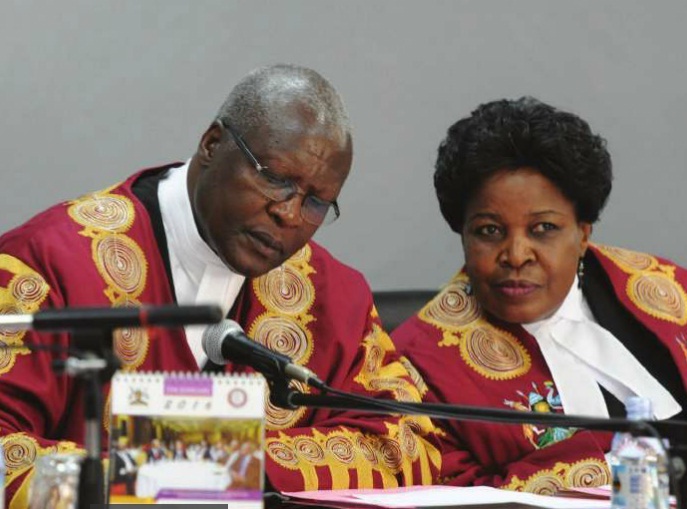
The Uganda supreme court.

SECTOR PRIORITIES FOR FY 2018/19
Justice, Law and Order
In FY 2018/19, the Sector will undertake the following;
  1. Continue to effectively implement the Case Backlog Reduction Strategy with a view to reducing case backlog to a single digit percentage within the next two years.
  2. Draft forty Bills; publish fifteen Bills, ten Acts, sixty Statutory Instruments, five Ordinances; and issue five Legal Notices under the auspices of the First Parliamentary Council (FPC). FPC will further draft bills for reform of the Public Health Act; Weights and Measurements Act; and Landlord and Tenant Relationship.
  3. Conclude anti-corruption and money laundering cases within an average of 132 days; conclude Professional Land Indicators in land crimes cases within an average time of 110 workdays; peruse case files for a decision to prosecute or not within average time of 44 workdays; sanction case files within an average time of 132 workdays and recover 10 per cent of proceeds of crime out of orders issued.
  4. Continue the implementation of the ICT Strategy which will include completion of the design and development of the Court Case Administration System including E-Filing, and the installation of a Video Conferencing System between the Buganda Road Chief Magistrates Court & the Luzira Maximum Prison Facility - Female Wing.
  5. In order to reduce the cost of doing business, the sector will continue to strengthen the land and commercial courts to reduce lead times in disposing of the cases and improving the administration of land cases through enhancing of the judicial officers in their areas of operation.
  6. The sector will focus to provide fast and effective dispute resolution in specialised areas and in the area of Alternative Dispute Resolution. This will include roll out initiatives such as mediation and small claims courts. Also rules and procedures that cause delays will be reviewed.
  7. In order to improve justice for children in the Karamoja region, a remand home in Moroto will be constructed.
Law and Order Enforcement
To enhance operations and staff welfare, Uganda Police Force plans to undertake the following in FY 2018/19:
  1. Complete 420 staff houses under Naguru Accommodation Project
  2. Construct Bukedea Police Station
  3. Complete vehicle maintenance centre at Namanve,
  4. Construct the Main Armoury at Nagalama Police Station,
  5. Effect payment of contractual obligation on fixed wing aircraft, operational vehicles & specialized equipment, and
  6. Develop operations and maintenance (O&M) facilities for helicopters and purchase a new VIP Helicopter (Four-year plan)
Civil Liberties and Freedom:
During FY 2018/19, UHRC plans to undertake the following;
  1. Conduct investigations of 2,000 cases both backlog and new ones
  2. Inspect 1,500 places of detentions in the country and monitor the refugee situation in the country especially in West Nile, Northern and Western Uganda
  3. Set up a tribunal to conclude 500 cases and mediate 400 cases.
  4. Continue with massive awareness campaigns, through community outreaches, media programs, students and the various stakeholders.
National Citizenship and Immigration Control
  1. In FY 2018/19, DCIC plans to scale up identification services through continued registration of citizens in Uganda, registration of citizens in the diaspora, alien registration and issuance of National and Alien ID cards.
  2. Furthermore, plans are underway to re-engineer business processes by enabling service delivery through ICT during the 4th Phase of the e-immigration system.
  3. The Automated Border Control (ABC) System will also be deployed at major borders entries of Katuna, Busia, Malaba, Cyanika, Mutukula, Elegu, Mpondwe, Mirama Hills, Vurra, Bunagana, Goli, Afogi, Lwakhakha, Ntoroko and Oraba DCIC will further facilitate entry, stay and exit of citizens and aliens in order to facilitate trade, investment and employment in the country, with a projection to process and issue at least 11,000 work permits to foreign workers.
Security
In FY 2018/19, the sector plans to:
  1. Acquire, refurbish and maintain defence and security equipment to support the Land Forces, Air Forces and Special Forces in pursuit of the mandates of providing and projecting Land Forces power in preservation and defense of the independence, sovereignty and territorial integrity of Uganda;
  2. Continue participating, through UPDF, in combat and non-combat operations including the provision of Aid to Civil Authority;
  3. Continue to provide accessible and quality healthcare to UPDF through delivery of promotive, preventive, curative and rehabilitative healthcare (Maternal and child health; malaria prevention, HIV/AIDS, TB; vaccination services before deployment; non-communicable diseases; mental health)
Regional Stability
In FY 2018/19, the security sector plans to:
  1. Promote regional and international peace and security especially in the Great Lakes Region and the horn of Africa including in Burundi, DRC, Somalia, Central African Republic and South Sudan.
  2. Strengthen bilateral relations with neighbouring countries through deepening regional integration and border demarcations with Kenya (marine border/Migingo), DRC (Rukwanzi Island/Vurra), Rwanda, Tanzania (Land and Marine borders) and South Sudan within the AU border demarcation programme among others. This will resolve trans-border conflicts, combat crimes like terrorism, human trafficking, small arms smuggling /proliferation and money laundering.
  3. Submit reports on Uganda’s compliance with UN Security Council resolutions.
  4. Support Uganda’s Disarmament Policy by effectively participating in Disarmament Conferences and the Non-Proliferation Treaty Negotiations.
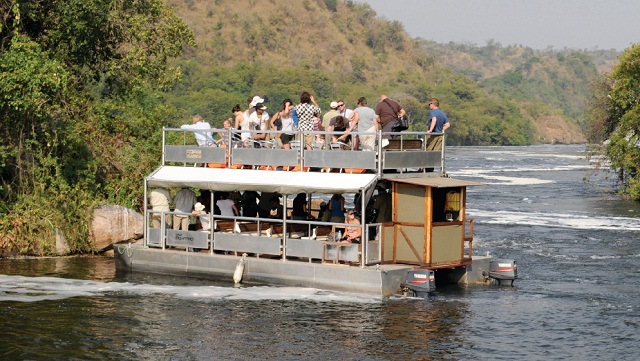
Tourists at Murchison falls National park. INDEPENDENT/JIMMY SIYA


Tourism and Hospitality
To further boost tourism travels to and within the country, Government plans to undertake the following in FY 2018/19:
  1. Finalize revival of the National airline;
  2. Upgrade five tourism aerodromes (Soroti, Kidepo, Pakuba, Jinja and Mbarara);
  3. Develop a modern water transport system forming a tourism circuit on Lake Victoria; and
  4. Capacity enhancement of KCCA to manage traffic flow within the city.
  5. Support, promote and ensure best practices in tourist facilities like hotels, restaurants and tour and travel companies through staff trainings; and
  6. Classify over 100 hotels and lodges for easy selection for tourists and train over 4 hotel staff.
  7. Train 400 hotel, 300 tour guides and 20 hotel assessors through a strategic intervention of capacity building, accommodation and hospitality registration and coordination;
  8. Conduct sensitization for 60,000 enterprises and 1,000,000 people to maintain internationally accepted standards in hotels; and
  9. Rate and classify 100 hotels and lodges.
Tourism Promotion and Marketing
In FY2018/19, Government will undertake the following:
  1. Reach 5 million Potential Domestic Tourists by hiring and deploying marketing and Public Relations firms, undertaking Media Campaigns, producing and distributing promotional materials;
  2. Expose 100 Uganda Tour Operators to Uganda’s products through Familiarisation (FAM) Trips for Tour Operators, media & other stakeholders;
  3. Reach 50 million potential international tourists, conduct awareness on Uganda’s products to 100 outbound tour operators, organize FAM trips (40 international media, 20 local media and 45 stakeholders) for leading media houses, journalists, social media influencers and tour operators from source markets;
  4. Sponsor sports personalities to promote Uganda; and
  5. Finalize the process of establishing a China-Uganda Friendship Tourism Chapter to market tourism in both countries. It will enable both local and Chinese investors to establish in tourism areas.
Legislature
In FY 2018/19, the sector plans to carry out the following activities:
  1. Fast-track the construction of the new chamber and acquire furniture and fixtures for the offices of the 453 Members as well as improve the ICT infrastructure.
  2. Carry out 150 oversight field visits to assess the performance of various government programmes being implemented by various sectors and the level of service delivery.
  3. Implement an effective monitoring and evaluation system for tracking institutional performance and outcomes in line with the good governance and democracy principles outlined in the NRM Manifesto. However, to achieve this, the sector plans to carry out over 150 sight visits to assess the performance of various government programmes being implemented by various sectors such as the youth, elderly, PWDs, children and women.
Public Sector Management
In FY 2018/19, the sector plans to:
  1. Produce, discuss and disseminate the GAPR for FY 2017/19 and to conduct Barazas in 50 districts.
  2. Monitor compliance to service delivery standards in 11 LGs and 6 MDAs
  3. Provide technical support to 4 Sectors (Social Development, Works and Transport, Agriculture andWater and Environment) on development of service delivery standards
  4. Provide technical support to 11 LGs and 15 MDAs on streamlining and set up of RIM Systems;
  5. Audit Records Management Systems in 12 MDAs and 24 LGs, and
  6. Finalise electronic records management policy and regulatory framework
Policy Coherence and Relevance
In FY 2018/19, the sector undertakes to: Coordinate Summit directives of the Northern Corridor Integration Projects including Free Movement of Labour; Regional Commodities Exchange; Investment and Tourism Promotion; Single Customs Territory; Standard Gauge Railway (SGR); Oil Refinery; Oil Pipeline; Power Generation, Distribution and Interconnectivity; Land acquisition for Infrastructure Corridor; Information Communication, Mutual Defence /Peace and Security strategies and Foreign Policy Framework implemented
Development Planning
During the FY 2018/19, the sector plans to;
  1. Finalise the 10-year National Development Plan;
  2. Commence drafting of the 3rd NDP including the macroeconomic strategy;
  3. Prepare NDP III sector and LG issue papers;
  4. Finalise the 10-year Human Resource/Manpower Plan (HRP);
  5. Continue alignment of sector plans and projects to the NDP II and Vision 2040 and support the development of Industrial Master Plan;
  6. Finalise an Iron and Steel Industry feasibility study report and produce guidelines for development of Regional and Strategic Cities
National and District Elections
In FY 2018/19, the Electoral Commission will continue with implementation of its functions. It also aims to undertake demarcation of constituencies and electoral areas in the newly created districts of Nabilatuk, Bugweri, Kasanda, Kwania, Kapelebyong and Kikuube.

Disaster Preparedness and Refugee Management
In FY 2018/19, 2,000 MTs of relief food and 5,000 assorted NFIs will be procured and distributed, 100,000 new refugees will be settled in conformity to international laws, 20,000 plots will be demarcated for new arrivals and 2 blocks of staff accommodation repaired in Kyaka II Refugee settlements.  A national risk atlas and contingency plan will also be developed

Infrastructural Development

TransportTraffic Flow and Signalization
Over the last five years, Government has directed efforts towards improving traffic flow in Kampala. In FY 2017/18, Government, through Kampala City Council (KCCA), installed traffic signals in six (6) major junctions in addition to widening some of the roads leading to the junctions. Government will in FY 2018/19 direct further efforts towards improving traffic flow in and around the city through expanding the roads, improving drainange systems and installing traffic lights among others.

Standard Gauge Railway (SGR)
In FY 2018/19 and in the medium term, Government will fast track implementation of the SGR project to ensure its completion so as to take advantage of socioeconomic and other benefits. Table 6.8 provides a cumulative summary of the SGR implementation progress in Uganda.

In FY 2018/19, Government will procure a total of 570 hectares of land on the eastern route to facilitate the SGR right of way.

Air Transport
The revival of the National Airline is a core project in NDPII and is one of the 21 directives of the National Resistance Movement Government for 2016-2021

Innovative ICT Opportunities
Government plans and priorities for FY 2018/19 include:
  1. Finalisation of the Digital Uganda Vision (DVU) which aims at building a digitally empowered society to foster innovation and create a positive social and economic impact through technologybased empowerment.
  2. Drafting a strategy to facilitate the implementation of E-commerce to reduce rural-urban divide in access to goods and services, promote online consumer protection will be developed;
  3. Implementation of the National ICT Innovation program (NIISP) to benefit Ugandans, targeting mainly women and youth; and
  4. Institutionalisation of IT and Communication functions across Government;
In FY 2018/19, Government will undertake the following:
  1. Finalization of the Sector Strategic Investment Plan to provide guidance and the general framework of implementation of Sector interventions;
  2. Profiling of research and innovations so as to take stock of all Research and Innovations country wide in order to design appropriate strategies;
  3. Finalization of the Review of the STI Policy;
  4. Implementation of the STI policy as per the defined framework;
  5. Dissemination/popularizing the Innovation Fund Modalities. This will provide knowledge of application and access to the fund;
  6. Developing Guidelines for Mainstreaming of STI across Government (MDAs and LGs); and
  7. Developing Scientific Research and Development policies and Guidelines in order to guide Research and Development initiatives within the Country
Higher Incomes for Agricultural Households

In FY2018/19, Government plans to achieve the following:
  1. Increase fishing in major bodies by 10 per cent;
  2. Control, contain and reduce the animal disease and vector outbreaks by 8 per centfrom the current 5 percent;
  3. Increase the number of animals produced for marketing from 5 percent to 7 per cent; and
  4. Continue supporting, promoting and guiding extension service delivery to attain the recommended extensioner worker/household ratio of 1:500.
  5. Continue with provision of subsidized farm inputs, improved agricultural infrastructure, postharvest handling technologies and more competitive prices for inputs and outputs to farmers in the clusters under the implementation of the ACDP projects in identified 42 districts among others Nebbi, Amuru, Ntungamo, Iganga and Kalungu.
Exports Development
In FY2018/19 Government  plans to achieve to the following:
  1. Discourage the export of raw coffee. The move is supported by a USD 500m (Ushs 1.8 trillion) investment from Italian coffee roasters, Euro Techno Group at Kampala Industrial Business Park
  2. Start exporting power to Democratic Republic of Congo for the next three years through a Memorandum of Understanding that was signed between the two countries in August 2017.
Industrial and Technological Development
In FY2018/19, Government plans to achieve the following:
  1. Establish Isingiro Fruit Factory - Feasibility study and Business Plan reports produced and Factory furnished with increased product storage cooling capacity system;
  2. Establish Zonal agro-processing facilities and a Food City Complex specifically to add value to cereals;
  3. Strengthen Mineral Processing: Lake Katwe Salt Project in Kasese District, Sponge Iron Ore Project in Kabale and Kisoro, Cement Manufacturing in Moroto and Sheet Glass Manufacturing at Diimu in Masaka; and
  4. Establish Tea Factories in Zombo, Nebbi, Mabaale and Kayonza.
Through the Rural Industrial Development Project, Government will:
  1. Strengthen Agricultural Marketing Cooperatives through establishment of collective marketing infrastructure;
  2. Train members of the beneficiary enterprises in business management and value addition skills;
  3. Support beneficiary enterprises to undertake product packaging, branding and quality certification;
  4. Establish Training and Common Facility/Incubation Centers; and
  5. Support beneficiary enterprises to develop bankable business plans, and assisting the enterprises on the programme to register patents and trademarks.
Micro, Small and Medium Enterprises (MSMEs)
In FY2018/19, Government plans to achieve the following:
  1. Commennced MSMEs Cluster formation and the common industrial facilities program not only to promote industrial development in the country, but also to increase light manufacturing products in mass production for export;
  2. Develop Katwe Metal Cluster land at Salam road into an SME industrial park with common industrial facilities to support the groups; and
  3. Scale up certification of MSMEs through UNBS so as to support exports especially to regional markets. It also plans to train SMEs through MTIC in Value Addition required for export destinations.
Cooperatives
In FY2018/19, Government plans to implement, among others, the following strategies under cooperatives:
  1. Transfer Cooperative Training Institutions from the Ministry of Education and Sports to the Ministry of Trade Industry and Cooperatives;
  2. Strengthen the policy and legal frameworks of cooperative societies;
  3. Promote value addition and collective marketing; and
  4. Improve access to financial services and capacity for the cooperative institutions.
Greater Kampala Metropolitan Area (GKMA)
In FY 2018/19, Government through  KCCA will undertake the following:
  1. Partner with the private sector to design, build, finance, operate and transfer a waste treatment and disposal facility capable of effectively managing municipal solid waste;
  2. Construct over 20 more signalized city junctions under the second Kampala Institutional and Infrastructure Development Project (KIIDP 2);
  3. Construct a stretch of 65km of drainage as planned for in the updated Kampala Drainage Master Plan;
  4. Finalize the development of the Multi Modal Transport Master Plan;
  5. Monitor GKMA for compliance to the land use regulatory framework;
  6. Roll out the Geo referenced database for Kampala properties and roads;
  7. Allocate street and plot addresses to properties; and
  8. Develop the cadastre maps and operationalize physical development plans.
Basic Education
In FY2018/19, Government will prioritize the following interventions:
  1. Construction and rehabilitation of classrooms, staff units and supply of desks to primary schools;
  2. Construction of 5,000 litre water tank, classrooms, stance latrines among other facilities in 83 primary schools under the Uganda Teacher Effectiveness project;
  3. Installation of one lightning arrestor per school for 11 primary schools in Iganga, Kibaale, Kasese, Luuka, Busia, Pallisa, Hoima, Kole, Mubende and 15 schools in Butambala districts susceptible to lightning;
  4. Construction of 2 blocks of 4-unit staff houses at Sheema, Gomba, Rakai, Gulu and Kumi; 2 blocks of 2 classrooms including furniture, multipurpose science laboratory and 2 blocks of 5 stance latrine at Sheema, Gulu, Kumi; 1 block of 2 classrooms including furniture, multipurpose science laboratory, and 2 blocks of 5 stance latrine; and
  5. Regulating the activities of private schools, more particularly reviewing the fees structure. This is paramount because over 35 per cent of students who drop out of schools cite unaffordable costs as the main reason[1].
Skills Development
In FY2018/19, Government will prioritize the following interventions:
  1. Fast track the establishment of the Skills Development Council that will be responsible for certification of skills for the oil and gas sector and subsequently promote the national content policy;
  2. Offer technical training for skills development by recruiting suitable teachers, fully equipping and manning them prior to expansion of new schools;
  3. Undertake curriculum development and reform to match skills required by industries; enabling youth without skills to acquire them through internship, and apprenticeship programmes; and
  4. Construction of John Kale Memorial Institute of science and technology in Kisoro district that offers courses such as mechatronics engineering, forensic science, tourism and marine science.
Rural Water
In the FY2018/19, Government will undertake the following key interventions:
  1. Construction of 70 Mini solar powered schemes and 30 solar powered micro irrigation systems countrywide;
  2. Finalize construction of 9 RGCs in Kyoga basin and Nyamiyonga-Katojo piped water system and engineering design of Isingiro Bukanga water supply;
  3. Complete construction of 100 hand pumped wells, 100 production wells and 70 large diameter wells across the country;
  4. Rehabilitate 4 gravity schemes in south western Uganda, 04 Designs of piped water supply systems completed;
  5. Construction of Water Surface Reservoirs and Purchase of Specialized Machinery & Equipment for regional centers;
  6. Purchase Specialized Machinery and Equipment such as Fish drying kits, Bee hives, extraction equipment, honey testing kits.
Labour Productivity and Employability
In the FY2018/19 and in the medium term, Government will through the sector focus on the following interventions:
  1. Promote decent employment opportunities and labour productivity;
  2. Boost effective participation of communities in the development process;
  3. Improve resilience and productive capacity of vulnerable groups for inclusive growth;
  4. Improve capacity of youth to harness their potential and increase self-employment, productivity and competitiveness;
  5. Promote rights, gender equality and women empowerment in the development process.
  6. Improve performance of Strengthening Decentralisation for Sustainability (SDS) institutions;
  7. Redressing imbalances and promoting equal opportunities for all;
  8. Earmark Ushs0.524Bn towards purchase of 1000 start-up business tool kits for Jua Kalis and Ushs1.016 for construction of one common user facility in Kampala;
  9. Government will finance 4,414 new youth groups from Youth Livelihood Programme;
  10. Government will finance 2,365 groups benefitting 23,650 women through the Uganda Women Entrepreneurship Programme;
  11. Government will conclude and sign bilateral labour agreements with other countries including Qatar, United Arab Emirates, Bahrain, Oman and Kuwait;
  12. Under the Green Jobs Programme, Government will establish Industrial Business Shelters, support more Jua-kalis with green technology and business green start-up tools and accreditation and roll out the Green Incubation Centers in all regions; and
  13. Government will prepare for the countrywide roll out of the Social Assistance Grant for Empowerment to cover all districts
******
SOURCE: BACKGROUND TO THE BUDGET Fiscal Year 2018/19 Ministry of Finance Uganda

Wednesday, 6 June 2018

7 DAYS TO GO: England To Rule The World after 1990 – THE SUN


The countdown to the World Cup is on, with it 7 days away now. Time to reflect on some quotes that have made the World Cup what it is..... via goal.com.

England To Rule The World – THE SUN

When England were eliminated on penalties by West Germany in the semi-final of Italia ’90, The Sun newspaper was so enthusiastic about the country’s future that they boldly printed the following:

“Around Gazza [Paul Gascoigne] and his young gang we can build a team to rule the world. Four years on, remember you read it first in the Sun!”

England failed to qualify for USA ‘94, and not a single one of the 23-man squad from Italia ’90 would play in another World Cup.

CLICK to READ THE TOP 10 INFAMOUS QUOTES

Tuesday, 5 June 2018

8 DAYS TO GO: A look back at when Gaucci sacked Ahn Jung-Hwan


The countdown to the World Cup is on, with it 8 days away now. Time to reflect on some quotes that have made the World Cup what it is..... via goal.com.

Gaucci Sacks Ahn Jung-Hwan

In the aftermath of South Korea’s infamous second round win over Italy at the 2002 World Cup, Perugia’s loopy president Luciano Gaucci sacked Ahn Jung-Hwan, who had scored the Golden Goal to knock the Azzurri out. Gaucci would later reverse his decision.

"That gentleman will never set foot in Perugia again,” boomed Gaucci.

"He was a phenomenon only when he played against Italy. 

"I am a nationalist and I regard such behaviour not only as an affront to Italian pride but also an offence to a country which two years ago opened its doors to him. 

"I have no intention of paying a salary to someone who has ruined Italian soccer.”

CLICK to READ THE TOP 10 INFAMOUS QUOTES

9 DAYS TO GO: A look back at Maradona's 'Hand of God'


The countdown to the World Cup is on, with it 9 days away now. Time to reflect on some quotes that have made the World Cup what it is..... via goal.com.

Diego Maradona’s Falklands Revenge

Argentina’s 2-1 quarter-final win over England in 1986 is as renowned for Maradona’s ‘Goal of the Century’ as it is for the ‘Hand of God’ opener when Diego fisted the ball past goalkeeper Peter Shilton.

After the match, Maradona explained that the victory was revenge for the Falklands War four years earlier that had resulted in the deaths of more than 600 Argentines.

“[The goal was scored] a little with the head of Maradona and a little with the hand of God,” said the Napoli hero.

"Although we had said before the game that football had nothing to do with the Malvinas war, we knew they had killed a lot of Argentine boys there, killed them like little birds. And this was revenge.”

READ THE TOP 10 INFAMOUS QUOTES